


This is Mark. Trying a longer, written Q&A excerpt format this week. A longer read but worth your time. Luke Distefano’s essays will return next week.

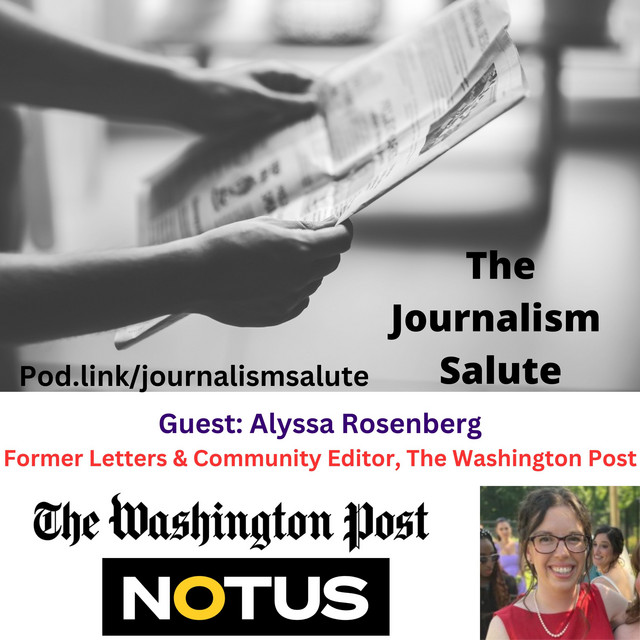
On this week’s podcast episode, we were joined by Alyssa Rosenberg. Alyssa is a former editor and columnist for The Washington Post. She was there for the last 11 and a half years. The last year and a half was spent as letters and community editor. After The Post declined to endorse a candidate in the 2024 presidential election, she invited readers to write in and promised to read all of their responses.
The result was 21,000 letters and over a six-month period. Alyssa read every one. She wrote about this recently for NOTUS.

We talked to her about her work and what she wrote.
I’ve excerpted from the interview here. Answers to these questions often ran longer than what I've shared here. If you wish to hear the full answers, listen to the episode.
MARK: Where are you from and what was the very first thing that got you interested in journalism?
ALYSSA ROSENBERG: “I grew up all over New England and I came to journalism when I was eight years old when my mother marched me down to the children's page editor of the local newspaper, back when there were local newspapers and children's pages, and somehow convinced them to give me a gig reviewing children's books for them.
I was paid in gift certificates to the local bookstore. I wrote that column for a while and it was really fun. When I left The Post, one of the first things I did was start a Substack about children's books because that interest has been so abiding.
But I didn't really figure out that I wanted to be in journalism until I was in college (Yale) and I took this legendary class called Daily Theme. And the way the class was structured, you had to turn in an assignment every day of the entire semester.
You have to write every day, even if the subject isn't something that you're interested in. And it just never stops. I loved the class. I got really competitive about it. I met one of my best friends in that class.
The professor said, this is a great way to test if you want to be a writer or a journalist because this is what the job is.
I was writing a column for the college newspaper at the time, sort of an extension of the political work I was doing.
But it was that class that really cemented for me that, oh, I just wanna be around words and ideas. And I wanna do that every day for the rest of my life.”
MARK: What did you want a Letters to the Editor page to look like?
ALYSSA ROSENBERG: “It should be fun. It should be eccentric. I think it should be warm and interesting. I think it should be a little bit more personal, a little bit more emotive.
One of my favorite letter writers was this woman named Barbara Morris, who was just a good writer. She had been writing to the Post for about 50 years, and she wrote about the substance of everyday life in a lot of ways. She would write over the debate over what constituted a bagel or her impressions when she was driving on a beautiful spring day and saw a group of teenagers.
She responded to articles too, of course, but she was just this sort of wonderful chronicler of life and had a fantastic imagination. She kept diaries her whole life, so she had wonderful materials to draw from. Reading Barbara just always made me enjoy the world a little bit more.
Not all letters to the editor are going to do that because not all news is cheerful. There are a lot of really awful things that happen in the world. There are a lot of really consequential things that happen in the world and letters to the editor is a place where people grapple with that.
I loved it when someone wrote in and was like:
'The real danger to Alaskans is not wolves, it's moose. Let me explain why.'
I didn't know how many people in Alaska are endangered by moose who charge their cars or fall on them. And now I know. I know so much more about the world because I was the letters editor than I ever would've learned otherwise.”
MARK: 21,000 letters, did they all come within a day, week, month?
How quickly did you get 'em?
ALYSSA ROSENBERG: “It must have been at least 10,000 the first day. I remember just sitting there and watching the inbox just move on the screen. As I was reading through them, I clocked whether I was getting closer to the end by whether the number that came per minute seemed to be falling.
It was really overwhelming. It was hard. And it was also tricky because that was the point at which I sort of just brought on some of my staff and I just didn't want them to have to deal with it. I just said, 'I'm gonna take this until it's done, because I'm the person who made the promise. You didn't make that promise, and I'll just handle this until it's over.'
And I did. It was a lot. I felt like I had made a promise and I had to keep it, and that may be kind of old-fashioned thinking, but I also felt at that moment that readers felt like 'The Post' had broken an implicit promise to them.”
It felt very important to me to keep an explicit promise to them, even if I had not been aware of what I was getting into.
MARK: The article you wrote for NOTUS has a solutions journalism aspect to it. You wrote lobbying for more congressional staffing to interact with constituents, even in the form of small gestures. And it noted that the citizenry needed to do its part too.
What would you say about the solutions that you brought up in this article?
ALYSSA ROSENBERG: “I think that there has been just a category error in the United States in the last 20 years, which is that tech companies, civic organizations, businesses have confused, allowing people to speak with, making them feel heard.
That is the source of a lot of sort of anger and frustration and polarization, right? Social media lets you speak, but it doesn't guarantee that anyone is gonna respond to you or that anyone who responds to you is gonna do so in a positive or affirming or way, or a way that carries the conversation forward.
If people genuinely feel heard, that is so depolarizing and affirming. And if someone feels genuinely heard, even if you can't give them the solution that they want, they may walk away less angry. Anger is an additional product of something going wrong and even you can't fix the thing that's gone wrong, you can reduce the symptoms.
To me, listening is inflammation reduction in the body. Maybe it's not the thing that is going to get rid of your pneumonia, but if it's the thing that lets you sleep through the night to get to the treatment for the pneumonia, that's actually really important.
And so the more opportunities we can get people to really be heard, to really be in conversation, the more we will build those muscles and reduce inflammation.
People have gotten so used to shouting that they have forgotten the value of a whisper or a question.”
Interrupting briefly. This reminded me of a situation from earlier this year in which members of the College Republicans at my alma mater publicly insulted and denigrated students at the school, including newspaper staff. I organized a ‘letter to the editor’ from a large group of alumni condemning the students’ actions.
Alyssa’s right. The inflammation reduction was powerful, so much so that it inspired me to take another step and send written questions to those running in our City Council primary. Each of them responded within 48 hours and again it made me feel good that I’d been heard.
MARK: How has being a journalist impacted how you view the world?
ALYSSA ROSENBERG: “I think the world is infinitely interesting and I think that everybody is the protagonist of their own stories.
Not everybody's story is equally nationally or internationally interesting. But there is just no end to things and people that I find interesting.”
MARK: And how do you view your purpose in journalism in November/December of 2025?
ALYSSA ROSENBERG: “I really appreciate that question in a way because I'm in this period of extreme experimentation.
I think that what I find myself really drawn to right now is helping people understand the techniques and power of journalism. The power of a well-crafted argument, the power of a well-researched argument or surprising piece of evidence, the joy of artfully-deployed language, the power of fact.
And you know what I loved about being the letters editor was that I could essentially teach these seminars one letter at a time, on American journalism, to individual people.
I think that the skills to be a good journalist are in so many ways, the skills to be a good citizen and the skills to live an interesting life.
And at a time when the profession is in a tough place, I think that can be a sort of civically and personally rejuvenating reminder.”
A reminder to professors and teachers
You can find episode guides that you can use if you wish to integrate the podcast within your classroom. There are more than 50 available. Each one has suggested questions for discussion and activities a class can do.
I’m also happy to help you find an episode that would be appropriate for what you’re teaching. Reach out to me at [email protected].
Additionally, I’ve curated some of the 2025 episodes into groups. If you’re teaching a class or unit in any of these subjects:
- Investigative Journalism
- Feature Writing
- Covering government policy
- Social justice, immigration, and identity
- Local News
Check out the sets of episode guides that would be useful to you. I don’t have a good term for them, so I’m borrowing from Bluesky and calling them “Starter Packs” - sets of 5-8 episodes in each category that may be useful in your classroom.