


On this episode we're joined by Monique Madan. Monique is an award-winning investigative journalist, advisor, educator, and a mother of two. She's also the founder of a newsletter Two Can Be True.
Monique has been a reporter in many prominent newsrooms, 13 years at The Miami Herald, as well as at USA Today, The Boston Herald, The Markup, and short stints at The New York Times and The Boston Globe.
She's a graduate of Miami Dade, one of my favorite schools, Emerson College, and has a masters from Harvard.
We talked to Monique about the challenges of being an independent investigative journalist, the stories she's written, the traits that make her a good journalist, and balancing her job with being a mom.
What was an early assignment for you that was like a turning point?
The Trayvon Martin story. I broke that story, so that was a really big turning point in my career. I was a part-time reporter covering the night cops beat at The Miami Herald, and I was also a college student.
I remember it being late at night, and my cellphone ringing, and it was Trayvon's uncle, whom I actually went to college with. I was writing a story about him and some disability rights for the college paper at that time, and we had built a relationship. And because of that relationship, and because I treated that story with the importance that it deserved, he called me on his worst day, and he said, "My nephew's coming home in a casket." And I remember the whole George Zimmerman narrative, and I just knew it was gonna be a big story. We got the story in the following day. We continued following up.
Do you remember anything that you did during that assignment that, that really that during that moment that really stands out to you now?
I had plans to have some hot chocolate when I got home. It was a really long day.
I remember just putting everything on pause and saying, "This is so important." It speaks to, as journalists, what we give up and the cadence of our work, and how sometimes it just overshadows our own needs.
Were you were you able to separate emotionally from it?
Absolutely. One of my biggest missions as a journalist is to humanize the journalist, but also to understand that there are boundaries. As journalists, we're always taught how to really put ourselves in these boxes and to not be human. How do we expect other people to be human with us when we can't be human with them?
So to answer your question, absolutely yes and that is a craft, but also it's about being genuine at all times. That has been my superpower, through and through, as a young journalist and now.
What exactly is Two Can Be True?
It's a newsletter, and the way I like to describe it is it's where my investigative reporting, my lived experience, my humanity, and also these narrative storytelling vignettes and essays all have a seat at the same table.
Usually people don't really know what goes behind the scenes of an investigation. Too Can Be True unveils that. Some people don't understand what it takes to do that journalism. Two Can Be True gives you a glimpse into that. It also humanizes the journalist, and I think more journalists should be doing that in order to continue building trust with communities.
You've reported extensively on the detention center that is known by the nickname Alligator Alcatraz, which is the Everblades Immigration Detention Facility.
You're well sourced there. You've written about a uniform patch that the guards were wearing that was pretty noteworthy, and you've also written about the status of the prison itself. Can you take us through your reporting and maybe a key thing or two that you did in order to get those stories?
Those stories were kind of born out of this trajectory of persistence in this field, in immigration reporting itself. I've covered immigration on and off throughout the years, so I'm very well sourced in that area. But at the end of the day, even if five years pass, I'd like to think that we still have to foster those relationships even if five years pass.
Even if there's a break in coverage these people still felt like they can trust me, and that's something that you build. So my coverage started off in Two Can Be True, and The Miami Herald republished that story, which was wonderful.
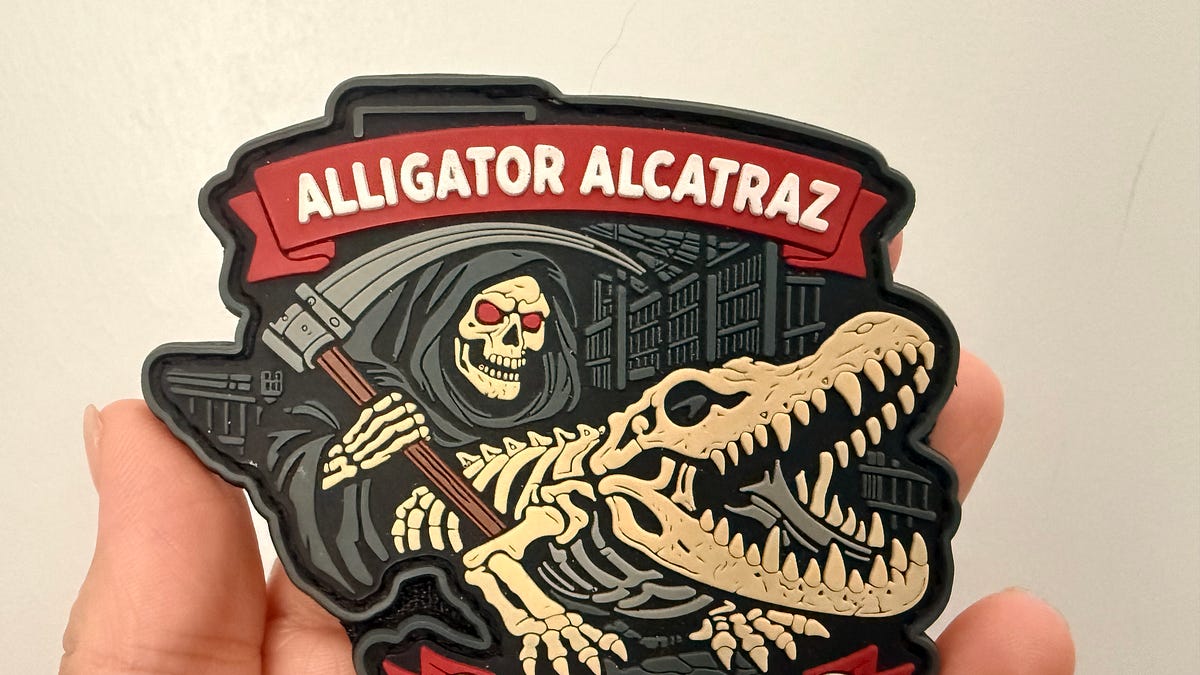
It started off with the narrative of this guard who was circulating grim reaper patches. And it really just blew people away because never in a million years did people physically see this patch or think that this patch would be worn inside detention. How did it get approved? There are a million questions. DHS still hasn't answered those yet. But I was well sourced enough to get some of those answers.
One of the things that stood out to me was in this new age of AI, reporting needs to go to another level. I had that patch mailed to me. I actually did not believe that the patch was real until I held it and that I was able to cross-reference it with some workers inside and people who had been inside without describing it to them.
So it was a process for me. It was very new to me because I didn't have an editor. I didn't have a masthead above me. It was my first investigative story out in Two Can Be True. And I think that it was a success in proving that journalists could still do this work without a masthead.
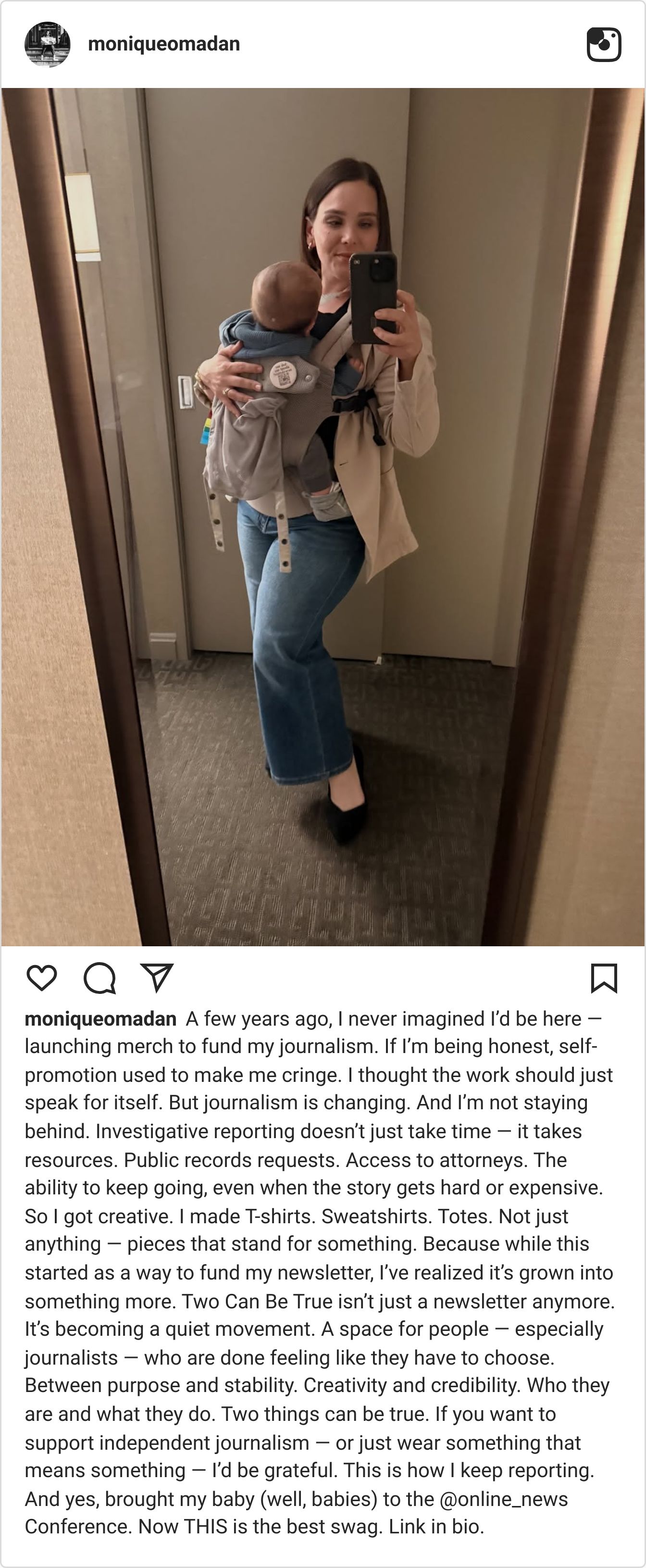
Why is it important that you're showing your work and showing how you do work and balance work and family?
Most journalists don't. I think the way people are consuming news is very different from before. And people want to relate. They wanna know that they can trust you, that you are like them. And I find great pride in that.
After having my kids, being a journalist in a box is just not sustainable, and I like to show my work. For me, it makes the work worth it, so why not show that part of my life?
I am very careful with how I do it. You won't see (her kids') faces or anything. I blur them and I don't share everything. But I do share glimpses of what it's like to do this work as a mother, and I think that we don't talk about it enough. As a parent, as a caregiver, or whatever season of life you're in, we don't talk about it enough. This is the season that I'm in, and it's very hard.
I know that I'm not the only one. The feedback has been wonderful. People saying, "Wow, I've been through that. Oh, I went through that. Finally I feel like someone's talking about this." Whether you're a journalist or not, moms across all industries have messaged me, and they feel very seen by it. I feel very proud because the work that we do, for example, those investigations, I did it with Cushion Mountain.
What is Cushion Mountain?
Just picture every pillow from your couch, cushion, pillow, just anything plushy on the floor in a mountain, reaching sky-high so that your toddler and your baby can climb it just so you could get a call in. It keeps them quiet enough because they're so curious.
They're trying to climb, and they're not screaming, and they're not running around. They're just trying to figure it out while you get your call in, and it's worked.
What advice would you have to a journalist who's been laid off?
It's emotional. I teach a workshop called Adaptive Leadership: How to Lead When the Title is Stripped Away, and I think the most important lesson you can learn if that ever happens to you is: you are not your job, and it's so important to know who you are yourself.
And when you reconnect with who you are without the title, without the company, without the accolades, without any of that, you will be okay, and you will find so much purpose, and you're gonna find the way. You're gonna do things that you love, and I write about this in one of my first posts in Two Can Be True.
When I was laid off, there's a senior mentor of mine who's just been in my life for a long time. I called her up, and we were talking, and she goes, "Girl, fired equals freedom." And I just thought that was crazy. I laughed at her, and she was not laughing. And I couldn't understand what she meant by that, and she proceeded to tell me, "Go do something that you have been wanting to do. Go knit. Go paint. Skydive." I will never skydive. But do something. Do something that you've wanted to do. There's freedom right now. I didn't know it at that point, but later on I truly realized that was actually gospel. There's freedom in that. And just if we can learn how to make something out of it, and like I said, that's how I approached this layoff.
E-mail me at [email protected]. If you have any thoughts on the podcast. I’d love to hear from you.

In 2025 we had a new episode each week and featured more than 60 guests. I don’t know that we were the most diverse journalist interviews podcast out there, but we certainly tried to be.
We look forward to bringing you more journalist interviews in 2026 but we can use your help. Tell a friend, a relative, a colleague about us and let them know that our episodes are worth their time.

A reminder to professors and teachers
You can find episode guides that you can use if you wish to integrate the podcast within your classroom. There are more than 50 available. Each one has suggested questions for discussion and activities a class can do.
I’m also happy to help you find an episode that would be appropriate for what you’re teaching. Reach out to me at [email protected].
Additionally, I’ve curated some of the 2025 episodes into groups. If you’re teaching a class or unit in any of these subjects:
- Investigative Journalism
- Feature Writing
- Covering government policy
- Social justice, immigration, and identity
- Local News

Check out the sets of episode guides that would be useful to you. I don’t have a good term for them, so I’m borrowing from Bluesky and calling them “Starter Packs” - sets of 5-8 episodes in each category that may be useful in your classroom.