

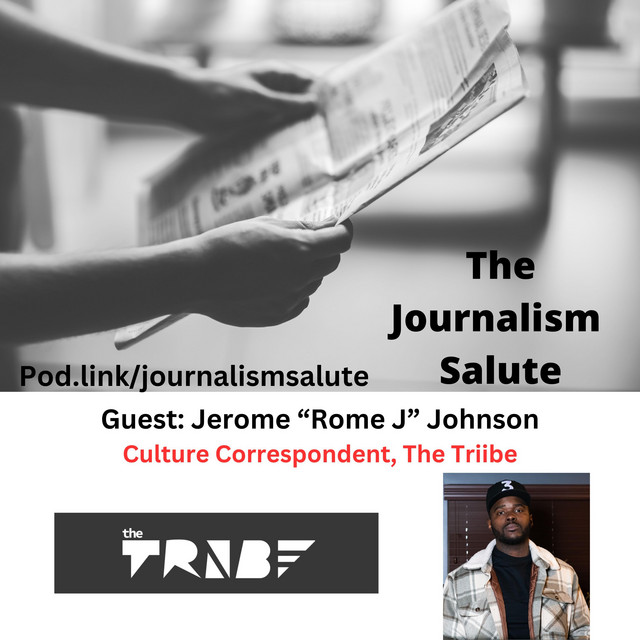
Chicago is rich in independent and diverse journalism outlets and that was our focus on the podcast this week when we talked to Jerome Johnson, also known as "Rome J." Jerome is a culture correspondent with The Triibe.
The Triibe is based in Chicago and its goal is to tell more thoughtful stories about Black people, stories that captured the multifaceted essence of their lived experiences, as well as solutions-driven stories that could teach and empower. It's aimed at a Black millennial audience. It was co-founded by Rome's sister, Morgan, The Tribe's publisher. It launched in 2017.
This is an interesting one with regards to the "who he is and what he does" aspect of this podcast. Jerome dropped out of college and was a car salesman with no previous journalism training prior to this job. He said it was "an easy transition" because of how comfortable he was asking people questions already. As I've said before on the podcast, journalism is for everyone.
The culture beat often touches on fashion, music, and sports, and we talked to Jerome in-depth about covering the latter two.
A lightly-edited excerpt from the interview is below. As always, we recommend that you listen to the episode.
What more should we know about The Triibe?
It exists to reshape the narrative of Black Chicago. Donald Trump was elected in 2016 and from the start of his administration to, even now, Chicago is not being painted in a good light. My sister basically said enough is enough. She decided to build The Triibe against the negative narration from mainstream media. It highlights and uplifts the positives of Black Chicago and brings awareness to the conditions that people are living in.
Instead of focusing on shootings, we like to focus on the conditions in a neighborhood that might lead to a shooting and what could we do to prevent another shooting. We're a small, passionate, hardworking team.
What is your approach to the beat and what makes Black Chicago so interesting to cover?
Chicago's biggest export is culture. There's so much going on that I pretty much have an endless well of topics to write about on any given day. My approach is to report it with the same seriousness as hard news, grounded in context and centered on people. I keep my ears to the streets and my eyes to the streets. You build relationships with people and you write what you feel.
(What's so interesting?) It's the people. It's the buildings. It's the lakefront, the food, the sports teams. The people make the city great and the job so fulfilling.
How do you cover something like the amazing season of the Chicago Bears as it relates to culture?
I wanted to cover the impact. So I'm seeing how they affect culture. It's also important for me to highlight to the world and for Black people, hey, look, there's space for Black Bears fans. I did a piece on The Family Den, which is a family-owned South Side restaurant and bar. They've been holding Bears Watch parties for the past 20 years. It is one of the South Side's best spots to catch a game, and it's just beautiful Black community and I think it's important that black people know spaces like that exist.
You also wrote about a music festival, Lollapalooza, and how Black musicians play to largely white audiences, and how the crowd reacts to them. What was that piece about?
I talked to a few artists (including) Chance the Rapper. We talked about the complexities of performing live and performing live as a Black artist in front of a predominantly white crowd and how the artists feel about that.
I talked about how I felt about that as a 33-, about-to-turn 34-year-old Black male, and more specifically how I feel about Black artists who use the N word or elect to use the N word. And being in a predominantly white crowd and hearing the N word.
It's an interesting conversation that I was trying to spark, which is basically, you make your art for you and your people. You know what your target audience is as a rapper, I'm sure. And so then it becomes a question of do you censor yourself or do you censor your art depending on who's in the crowd?
What would you say to someone who's thinking about a career in journalism but isn't sure it's for them?
You gotta give it your all. Before it gets too late, go ahead and just dive in. It's not easy. Some days, some nights I don't go to sleep if there's a deadline and I gotta hit it. I bring my work home all the time, so just be prepared for it.
It's an extremely rewarding job. I've been able to live out my dreams doing journalism. For anybody who wants to try it, I tip my hat to them. I'm proud of myself for sticking with this. I've wanted to quit many times but I'm happy to have made it eight years.
I have a saying for those looking to be journalists. Artists get to work on an album. When it's done, it gets promoted, they tour, they celebrate the album and they perform the album. As a journalist, you make an album every article. There's no time to celebrate your work. Nobody is gonna clap for you.
So you just move on, focused and know that you're doing it for you.
In 2025 we had a new episode each week and featured more than 60 guests. I don’t know that we were the most diverse journalist interviews podcast out there, but we certainly tried to be.
We look forward to bringing you more journalist interviews in 2026 but we can use your help. Tell a friend, a relative, a colleague about us and let them know that our episodes are worth their time.

A reminder to professors and teachers
You can find episode guides that you can use if you wish to integrate the podcast within your classroom. There are more than 50 available. Each one has suggested questions for discussion and activities a class can do.
I’m also happy to help you find an episode that would be appropriate for what you’re teaching. Reach out to me at [email protected].
Additionally, I’ve curated some of the 2025 episodes into groups. If you’re teaching a class or unit in any of these subjects:
- Investigative Journalism
- Feature Writing
- Covering government policy
- Social justice, immigration, and identity
- Local News

Check out the sets of episode guides that would be useful to you. I don’t have a good term for them, so I’m borrowing from Bluesky and calling them “Starter Packs” - sets of 5-8 episodes in each category that may be useful in your classroom.