


I'm Mark Simon and welcome to The Journalism Salute. On this episode, I was joined by Heather Morrison. Heather is a managing producer for MassLive.com based in Springfield, Massachusetts. She's previously been a reporter and a social media producer with them.
Heather is a graduate of the University of Missouri, class of 2015 with degrees in religious studies and journalism.
Heather talked about Mass Live's social media strategy and her approach to running the organization's accounts, such as Instagram and TikTok. She explained the different types of things she's tried, how she deals with viewer comments, and provided advice for those interested in pursuing social media account management as a job.
So, what exactly is your job and how do you explain it to people?
Not easily. It depends on who I'm talking to, If I'm talking to someone in their 20s or 30s, I basically say "I'm a news influencer, and basically that means I'm trying to influence you to care about local news. I'm not trying to influence you in necessarily what to think or to go buy something, but I just want you to care about local news."
If I am talking to someone who's older than that or even trying to explain it to my parents, I tell them that I am a content creator and that I create short-form videos for news and that everyone is scrolling. And so, I basically say that any time you're scrolling on Facebook or Instagram, and you happen to see information about news," I just want that to be me or another journalist. And usually people understand, because everyone's scrolling.
I learned a lot about your parent company, Advance Publications, last September when Joshua Benton of Nieman Lab, posted about its success as part of the Advance Local chain.
He pointed out that there's a lot of things that people are going to want to read there, in the form of pop culture, national news aggregation, along with a high volume of stories. I get the sense that there's some of that in your job. For example, covering big wins at the Springfield casino. But you're also covering a lot of local hard news, particularly criminal court cases and things that are more traditional news in nature.
What is the mix for you?
What I really enjoy is that any time I come up with a story idea that I think is easy to do, worth doing, I'm capable of doing, any of those things, then I'm pretty much allowed to do it.
Sometimes, I pass those off. But I love writing hard news. Writing breaking news when it's oftentimes sad breaking news or very serious breaking news, to me, just gets really exhausting. I understand it's so important. I led the breaking news team for six years. I know how important it is, but it can be really exhausting mentally. I always try to have something that our reporters, including myself, can grab that just feels a little bit easier.
(Besides casino winnings), I also do something that we used to call Pet Project. I usually just focus on one dog, cat, animal and blast it out there. And I've actually gotten many animals adopted because of these articles, which take me 15 minutes to write.
I'm not spending a lot of time on them, but people really like them, and then it does a lot of good for our community as far as local news goes.
This blended into a second answer in which Heather talked about her daily work.
Yesterday I pretty much spent the entire day turning other people's stories into videos so that it could get out on social media. Today I went to a historic Springfield home that is for sale, the William McKnight Home. It's incredible. I walked through this incredible house on video. They basically got to come with me to explore this house. And then I created a video off that.
On top of all of that, I am still doing longer form hard news. Right. I do have a couple of big projects that I'm working on. And so, every week I try to spend a little bit of time digging into those. A lot of them right now involves setting up an interview and waiting for that interview or doing a public records request and then waiting for that.
So the longer projects do take a lot more time.
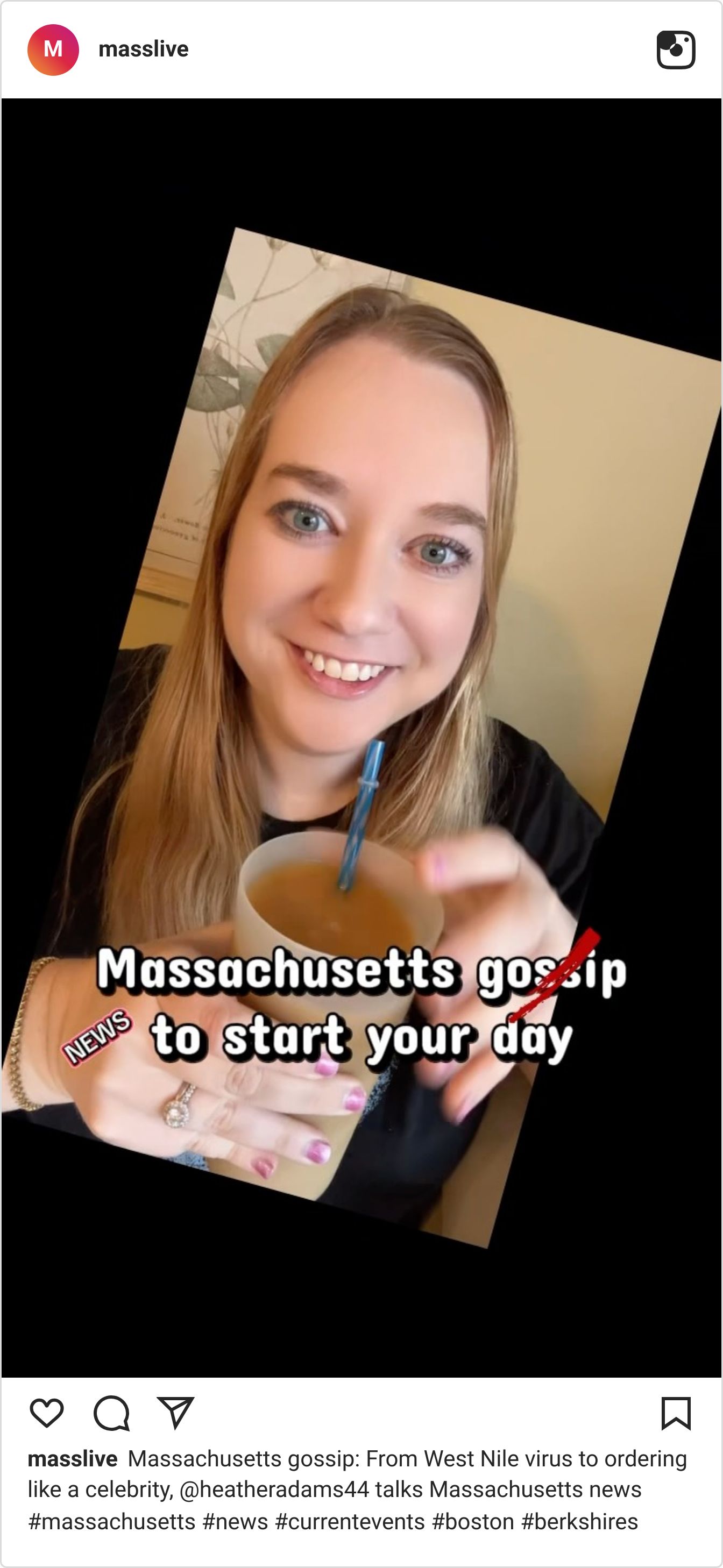
You've done some videos where it's from the point of view of your best friend calling you with the latest drama, and then it turns out that it's hard news about some serious court case or political story. Or 'morning gossip' along the same lines. You're trying to find a way to meet these people on the other side where they are.
Can you explain the whole strategy behind that?
I think for a really long time journalism just doesn't feel approachable to people. It doesn't feel like it's for them, especially local news. I mean, this is for the people. This is for our neighbors. And there have been countless times where I'm talking to someone, a friend who's not a journalist, and I'll be like, "Did you hear about this crazy thing?"
Just us talking. And they'll be like, "No." And I was like, "You didn't read that news story?" Sometimes I'll even be like, "I sent it to you." And they're like, "Oh, I didn't know it was that interesting. I didn't click." And I'm just like, "No, it was that interesting."
I think as journalists we forget how busy people are. People are so incredibly busy. They are not sitting down, with a newspaper having coffee well before work. They're running around doing things. The few minutes that they have, they're likely scrolling. That's what I'm doing. So how do we make news approachable?
One of my ways was, I do this with my friends all the time: I'm like, "Listen to this crazy thing." So why can't I just make that a video And, put disclaimers that like this is clearly an act, but it is a real news story? I'm being upfront about it.
And then the gossip aspect of it all, I just thought that was so fun because I think that, again, news gets a really bad rap. It's always negative, it's always bad. And I'm like, okay, well, what if we just make it a little gossip sesh? And that makes it more approachable for people, and I think too, again, it just makes people get in the door.
Those videos do not go super in-depth. I have other videos that do go super in-depth, but they may not listen to those videos.
You're on-camera and a part of a lot of the videos you make and the world sucks in that female reporters who do these sorts of videos have to put up with a lot more from their viewership than male ones would. Have you had to deal with that at all? What has your experience been?
So, Nick O'Malley does our 'Anywhere' coverage, and not that he doesn't ever get a negative comment 'cause I am sure that he does, but he does not get nearly as many negative comments as I do about random appearance things. Whether that's "You're too close to the camera," or "I can see your pores." I am fairly certain no one has ever commented about his pores.
People are way more willing to tell me that I'm annoying or to go away than I think they would a man. But I'm not going away, and I have much tougher skin than that.
@masslivenews President Donald Trump denies Massachusetts’ disaster declaration request for February blizzard #news #massachusetts #currentevents #blizz... See more
There's a comedian, Roy Wood Jr., who said in an interview once that with his face, there are certain jokes that just don't work for him. They can't be told from his face. And you come across in your videos, as someone who likes to share things with people, a very friendly face.
Is there anything that you find that you have a harder time doing on video than others? And two, how long did it take you to find your on-camera approach?
I've had to really work on not laughing when it's serious news. Yep. And not because I find it funny, but it's just my nervous reaction. People will be like, "Why are you smiling?" And I was like, "I don't know. I was on camera. There was a camera. I smiled." It was subconscious.
I really did have to learn to watch out for that, refilm if I do it. I'm never gonna be perfect about it, but yeah, there's times where I was like, "Why did I smile at the end of that? That was not a smiling thing."
We are reporting very heavily on the Michael Proctor situation which is a former Massachusetts State Police trooper who texted- the most racist things that I have ever read. And I then have to turn around and be the face of that.
And for that I have gotten far more positive comments than negative ones. People really appreciated us bringing attention to this. But I do know, and there have been some critiques of, why am I being the one to report on this? I do think that there is room for diversity in that. Journalism needs to absolutely fix that problem and then bring those faces to the front and to cameras.
@masslivenews More racists texts by former Massachusetts State Police Trooper Michael Proctor have been released. #breakingnews #karenread #massachusett... See more
How has being a journalist impacted how you view the world?
I think I'm a nicer, kinder person because I'm a journalist. I get to talk to so many different people and I get to hear so many life experiences that I never would have understood before.
And also I get to then talk to experts oftentimes about those life experiences and understand them to a level that I never would have before.
E-mail me at [email protected] if you have any thoughts on the podcast. I’d love to hear from you.

In 2025 we had a new episode each week and featured more than 60 guests. I don’t know that we were the most diverse journalist interviews podcast out there, but we certainly tried to be.
We look forward to bringing you more journalist interviews in 2026 but we can use your help. Tell a friend, a relative, a colleague about us and let them know that our episodes are worth their time.

A reminder to professors and teachers
You can find episode guides that you can use if you wish to integrate the podcast within your classroom. There are more than 50 available. Each one has suggested questions for discussion and activities a class can do.
I’m also happy to help you find an episode that would be appropriate for what you’re teaching. Reach out to me at [email protected].
Additionally, I’ve curated some of the 2025 episodes into groups. If you’re teaching a class or unit in any of these subjects:
- Investigative Journalism
- Feature Writing
- Covering government policy
- Social justice, immigration, and identity
- Local News

Check out the sets of episode guides that would be useful to you. I don’t have a good term for them, so I’m borrowing from Bluesky and calling them “Starter Packs” - sets of 5-8 episodes in each category that may be useful in your classroom.